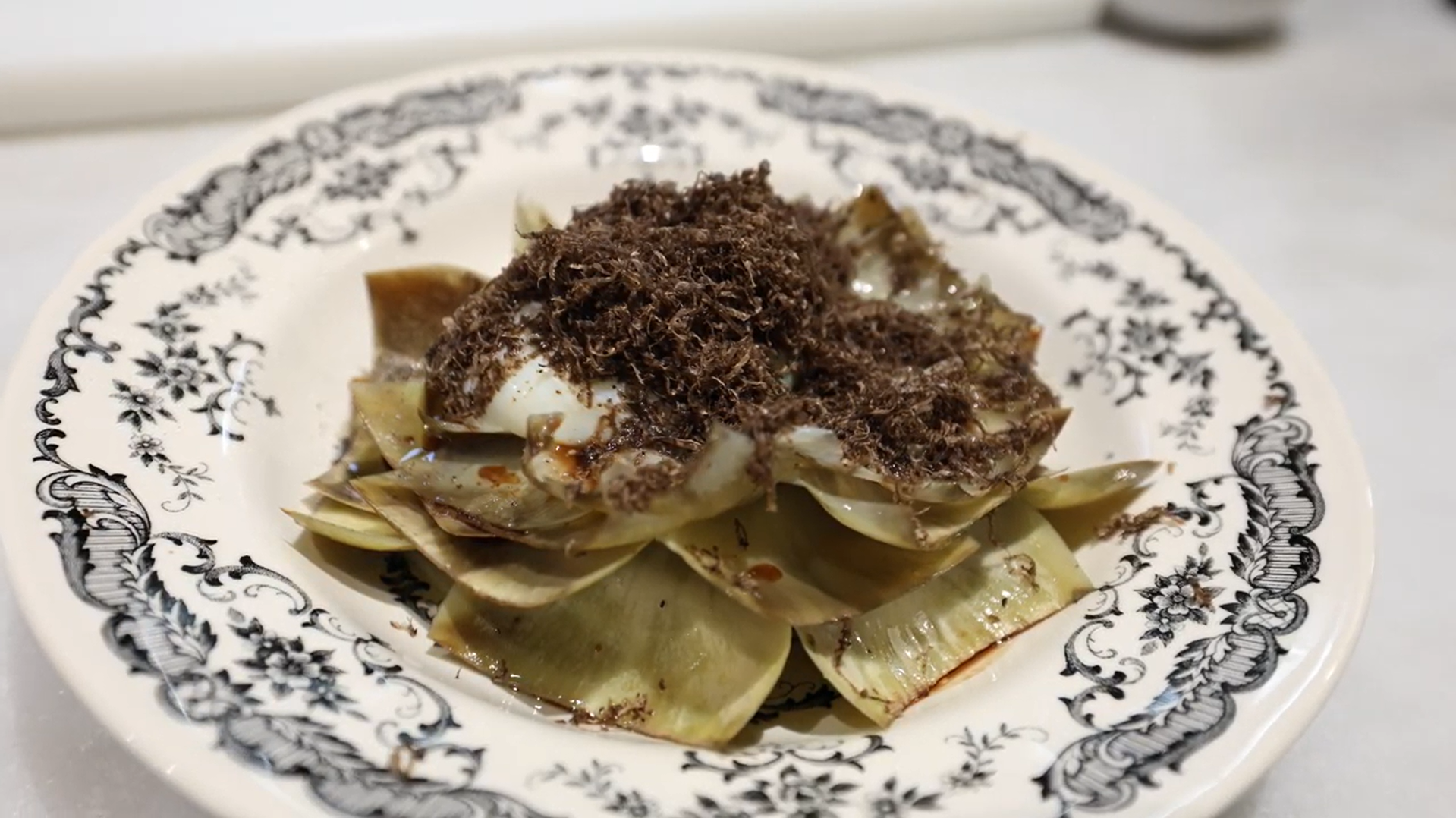
At BarcelonaMilano, artichoke with egg is enjoyed as a dish that combines delicacy and depth: the vegetal tenderness of the artichoke, the barely contained yolk of the poached egg and the earthy perfume of the black truffle create a silky, warm and elegant blend. It is an ideal dish for a special starter or for a leisurely meal in which every detail matters.
Ingredients
1. Oven-baked artichoke base
- 8 Prat artichokes
- 150 ml of mineral water
- 450 g of olive oil
- 1 g of ascorbic acid per litre of water for preservation, or lemon, to prevent oxidation
- Salt, to taste
- Ground black pepper, to taste
2. Poached eggs in a home Roner
- 8 eggs
- Water, as needed
- Ice water, as needed to cool down
3. Manually poached egg
- 1 egg per serving
- Water, as needed
- Kitchen paper, for draining
4. Demi-glace sauce
- 1 dry onion
- 4 leeks
- 6 carrots
- 10 ripe tomatoes
- 1 head of garlic
- 5 g of fresh thyme
- 4 g of fresh rosemary
- Olive oil, as needed
- 625 ml of red wine
- 312 ml of rancio wine
- 6 kg of veal bones
- 1 veal trotter
- Water, as needed
5. Assembly per serving
- 1 oven-baked artichoke
- 1 poached egg
- 1 tablespoon of demi-glace
- EVOO, to taste
- Maldon salt, to taste
- Freshly ground black pepper, to taste
- 2 g of black truffle (Tuber melanosporum)
Preparation
1. Preparing the oven-baked artichokes
Peel the artichokes, removing the toughest outer leaves and trimming the stem until only the tender part remains. As you clean them, keep them in water with ascorbic acid, at a rate of 1 g per litre, or in water with lemon, to prevent them from blackening due to oxidation.
Drain them well and place them on a baking tray. Add the 150 ml of mineral water, season with salt and ground black pepper and cover with the 450 g of olive oil. Seal the tray carefully with aluminium foil so that no steam is lost during cooking.
Bake in dry heat mode at 180 ºC, with fan at speed 3, for approximately 50-55 minutes. The time may vary depending on the size of the artichoke and the point of the season. Once cooked, leave the artichokes to cool while covered so they keep their moisture and melting texture.
2. Cooking the poached egg in a home Roner
Set the Roner to 63 ºC for 40 minutes. When the water reaches the temperature, place the eggs in and keep them there until the indicated time is complete.
Remove them and transfer them immediately to ice water to stop the cooking. If you are not going to use them right away, store them in the fridge. To regenerate them, submerge them in water at 80 ºC for 2 minutes before plating. Then, crack each egg into a bowl very carefully to keep the structure intact.
3. Alternative: manually poached egg
If you prefer to prepare this artichoke with egg without a Roner, poach the egg directly in water at 80-90 ºC, without shell, for 2.5 to 3 minutes. Remove it with a slotted spoon and let it drain on kitchen paper. The goal is to achieve a delicately set white and a fluid yolk, ready to melt over the artichoke.
4. Preparing the demi-glace sauce
Wash and cut the vegetables. In the case of the onion, you can leave the skin on to intensify the final colour of the sauce. Set the tomato aside once chopped.
In a large pot, heat a base of olive oil and brown the onion, the leeks, the carrots and the heads of garlic cut in half together with the fresh thyme and fresh rosemary. When the vegetables are well sautéed and show toasted notes, add the tomato and continue cooking for a few more minutes.
Add the rancio wine and red wine, and reduce the whole mixture by half to concentrate the aromas.
Separately, blanch the veal bones and veal trotter in plenty of water for 10 minutes. Repeat this process twice, washing the bones and trotter with clean water after each blanching. This step helps to obtain a cleaner and more refined sauce.
Add the bones and trotter to the pot with the vegetables. Cover with water and keep at medium heat for about 36 hours, adding water whenever the level drops. On the third day, when the sauce has reached the right colour and density, stop adding water and reduce until you obtain the desired texture. Strain carefully.
The demi-glace should be very shiny, dark, almost black, yet light on the palate. This sauce provides the flavour base that gives depth to the artichoke with egg and ties together all the elements of the dish.
5. Regeneration and assembly of the artichoke
For each serving, place 1 oven-baked artichoke on a tray or oven-safe container and heat for 3 minutes at 180 ºC, with fan at speed 3 and humidity at 30 %.
Transfer it to the plate and gently open it into a flower shape. Sauce it with 1 tablespoon of demi-glace, making sure the sauce seeps slightly between the leaves so that the base is well impregnated.
Place the poached egg in the centre of the artichoke. Finish with a drizzle of EVOO, a few flakes of Maldon salt and freshly ground black pepper. At this point, the artichoke with egg already shows its balance between juiciness, intensity and aromatic freshness.
Decoration
Finishing ingredients
- 2 g of black truffle (Tuber melanosporum) per serving
- An additional drizzle of EVOO
- An extra touch of Maldon salt, if desired
- Freshly ground black pepper from the mill
Final presentation
Grate the black truffle directly over the egg and part of the artichoke just before serving, to preserve all its fragrance. Present the artichoke open, with the egg in the centre and the demi-glace surrounding the base of the dish. The visual contrast between the muted green of the artichoke, the dark shine of the sauce and the creamy yolk makes this artichoke with egg especially attractive to the eye.
A dish to keep in your memory
Few recipes convey so much with so few elements as this artichoke with egg. There is technique, product and a very precise balance between simplicity and sophistication. At BarcelonaMilano, this type of preparation sums up a way of understanding cooking: respect for the ingredient, precision in the process and pleasure in every spoonful. If you dare to prepare it at home, share it, serve it without haste and let the yolk, the demi-glace and the truffle do the rest.
We’ve put together this video so you can watch the whole preparation process, guided by our chef: